
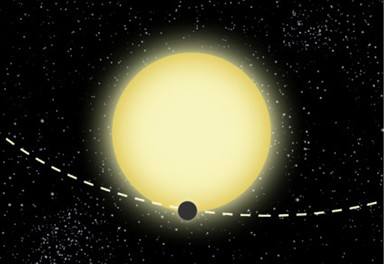
Pi star: A planet with a 3.14 Day Orbit
Advertisement
Scientists at MIT and elsewhere have found delightful coincidences between newly discovered planets and mathematical constants. The newly discovered planet Pi Earth, the size of the Earth, is named as it takes 3.14 Earth days to complete an orbit of its star.
When analyzing data obtained by NASA's Kepler Space Telescope's K2 mission in 2017, researchers found clues about this planet. Through the verification of the system using the ground-based telescope network SPECULOOS earlier this year, the research team confirmed that those signals represent the presence of a planet orbiting its star at the target location. At the same time, calculations found that the Orbit of its star takes 3.14 days.
Prajwal Niraula, a post graduate in the Department of Earth's Atmosphere and Planetary Sciences (EAPS) at the Massachusetts Institute of Technology, said: "Planets work like clockwork." He is the lead author of the paper (published in Astronomical Journal).
Co-author Julien de Wit said in the paper: "Nowadays, everyone needs to have some fun."
The new planet is numbered K2-315b; as it is the 315th planet discovered in the K2 data.
Advertisement
Researchers estimate that the radius of K2-315b is 0.95 the radius of the earth, which makes it about the same size as the earth. It orbits a low-mass star, which is about one-fifth the size of the sun. The planet orbits its star every 3.14 days at a speed of up to 81 kilometers per second.
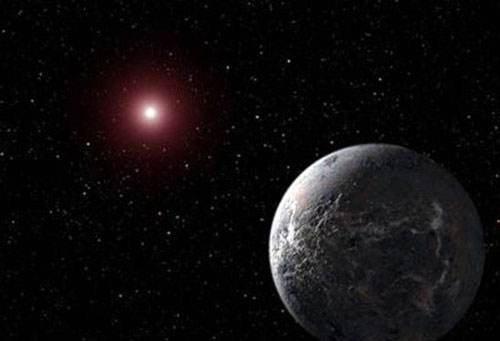
Although its mass has not yet been determined, scientists suspect that it is similar to the earth. But the pi star may not be habitable. Considering the Newtonian dynamics learned in high school, its orbit speed is related to the orbit radius - the closer you are to the star, the greater the speed. So the planet's surface temperature may be 450 Kelvin.
Researchers say that Pi star may be a promising candidate in other areas, such as testing the James Webb Space Telescope (JWST) to explore the details of planetary atmospheres. Currently, the team is collecting other data, such as the data set from NASA's TESS mission, and also calling the rest of the Artemis and SPECULOOS networks to directly observe space to find more terrestrial planets.
Niraula said: "There will be more interesting planets in the future, just to catch up with JWST. If there are better algorithms, I hope that one day, we can find smaller planets, even as small as Mars.
Advertisement
 1
1 1
1- Previous article
- Why the speed of foreign object passing through the superfluid can exceed the critical limit
- Next article
- Playing video games as a child is proven to bring lasting improvement in cognitive ability
Advertisement
OTHER NEWS

Lazada: Record-Breaking Sales on Double Eleven
BY Joan

Rough user portraits of Gen Z mobile game players
BY Heather

Why the speed of foreign object passing through the superfluid can exceed the critical limit
BY Louise

Fleets: Twitter Launches Disappearing Tweets Tool
BY Emily

E-Commerce Giant Amazon Launches Online Academy “Amazon Academy” in India
BY Turner

The AI adds a face in the background when zooming in on photos
BY Kimberly
RECENT NEWS
-

How to Download and Install Wyze App for Free?
-

How to Download and Install VIX for Free?
-
How to Download and Install Minecraft?
-

How to Get Free Units in Marvel Contest of Champions?
-

How to Get Free Strawberries in Transformice?
-

Indian Kids-Focused Fintech Platform Junio Has Raised Seed Capita